Category: EDCI 336 (Page 2 of 2)

This is a category for the EdTech course. Please add this category in addition to the relevant edtech assignment category(ies).

Free Inquiry Week 6: When Compassion Hurts

Fisher Farm – Photo Taken By Sophie Henderson

In recent weeks, my inquiry has focused on the power of compassion in education and how it supports student well-being, strengthens relationships, and builds more humane school communities. Yet compassion, while transformative, also carries a cost. Teaching is emotionally charged work, and when educators pour themselves into caring for others within systems that do not always care for them, the result can be exhaustion, moral distress, and eventually, what Santoro (2011) calls demoralization.

The Emotional Toll of Compassion

The emotional demands of teaching have long been described through the language of burnout, but Santoro (2011) argues that burnout is often a misdiagnosis. Burnout suggests that teachers lack resilience, energy, or psychological resources to meet the demands of the work. Demoralization, by contrast, occurs when teachers are prevented from doing the work in ways they believe are right and good. When policy, testing mandates, or systemic inequities block teachers from accessing the moral rewards of their profession (the sense that what they do is meaningful, ethical, and worthwhile) they lose something far deeper than energy. They lose purpose.

As Santoro writes,

“It is well established that the moral dimensions of teaching — the opportunity to do good work — are a central feature of the profession.”

When teachers feel that this moral dimension is stripped away, the result is not just fatigue but moral injury, which is the pain of being complicit in a system that harms the very children one entered the profession to help.

A Personal Reflection: Compassion and Its Edges

During my first practicum, I met a little girl in Kindergarten who was being neglected at home. Her parents both struggled with mental health, and many mornings she arrived at school hungry, dirty, or not at all. Her older sister, only in second grade, was effectively her caregiver. My mentor teacher and I conducted daily health and hygiene checks for the sisters, ensuring they were safe and cared for while at school.

When we finally met their father at the spring student-led conferences, it was the first time my mentor had ever seen either parent. He appeared unwell, and was visibly struggling. My initial reaction was anger. I was furious that he allowed his daughters to live in such conditions, that such a burden fell on two small children. Later, my mentor reminded me that anger, while human, can cloud compassion, that he too was suffering, and his very presence at the conference represented an enormous step forward.

That conversation changed my perspective. When I allowed myself to see him not as neglectful but as unwell and trying, I could reorient myself from judgment to empathy. I realized that compassion in teaching is not just about caring for students, it is about holding space for the humanity of their families too.

Still, the experience weighed heavily on me. I thought of that little girl every night. I carried her story home long after the practicum ended. That emotional residue, or the inability to “shut off” care, is both the gift and the burden of compassionate teaching. Without boundaries, reflection, or support, it becomes unsustainable.

Compassion Fatigue and Self-Compassion

Santoro’s framework helps illuminate experiences like mine. Teachers often internalize systemic failures as personal ones. When students suffer, we feel responsible. When we cannot “fix” their circumstances, we feel helpless. Over time, this dynamic creates what psychologists call compassion fatigue, or the emotional exhaustion that comes from giving empathy without replenishment.

Self-compassion becomes an act of resistance against this fatigue. It involves acknowledging our limits without guilt and extending the same kindness to ourselves that we offer to others. For me, recovering from that practicum meant accepting that I could not change a family’s situation, but I could offer safety, routine, and love within the small window of the classroom. I learned that compassion is not all or nothing; it must be shared with ourselves if it is to endure.

Systemic Tensions: Compassion Versus Compliance

The tension between compassion and compliance lies at the heart of demoralization. Systems that prioritize metrics over meaning, like attendance targets, behavior charts, standardized testing, often create conditions where teachers are forced to act against their values. Santoro describes a teacher named Rosa who was compelled to impose tasks on her students that both she and they knew they could not perform. Rosa’s distress, Santoro explains, was “moral depression — the precursor to demoralization.” She was successful by institutional standards, yet morally devastated.

To illustrate this conflict, consider the following comparison:

A Compassionate ResponseA Compliance-Based Response
A teacher notices a student falling asleep in class. Instead of reprimanding them, she checks in privately and learns that the student is caring for younger siblings at night. She arranges with the principal for the student to take brief rest breaks and partners with the school counsellor to provide support.A teacher notices a student falling asleep in class. She follows policy by recording repeated incidents of “off-task behaviour” and escalating it to administration. The student receives detention and begins skipping class altogether.
Outcome: The student feels seen, trust grows, and the teacher’s sense of purpose is affirmed. The class climate improves.Outcome: The student disengages further. The teacher feels frustrated and disillusioned. The system’s focus on compliance erodes compassion for both.
Made in Collaboration with Chat-GPT

This simple case shows how institutional structures can either nurture or corrode compassion. When systems value relational understanding, they sustain teachers’ moral energy. When they prioritize control, they risk demoralization.

Protecting Compassion: Structural Supports for Educators

Compassion can only thrive in conditions that support it. Expecting teachers to sustain empathy indefinitely, without systemic care, is unrealistic. Schools can help protect compassion through:

  • Co-regulation time: built-in moments for staff to debrief emotionally demanding experiences, normalizing vulnerability and shared reflection.
  • Professional Learning Communities (PLCs): where educators collectively explore challenges and reaffirm the moral purpose of their work.
  • Self-care policies: that move beyond individual wellness tips to structural changes, such as reduced administrative load, mentorship programs, or mental health days.

Santoro (2011) reminds us that good teaching is not only about cultivating individual teachers’ dispositions toward good work but structuring the work to enable practitioners to do good within its domain. Compassionate systems leadership begins here,  not with heroic acts of individual care, but with collective efforts to make compassion sustainable.

Closing Reflection

It is hardest to remain compassionate when exhaustion meets injustice, like when we see suffering we cannot fix, or when we are asked to prioritize compliance over care. What helps me recover is remembering that compassion is not a finite resource but a rhythm: giving and receiving, holding and letting go. When schools honour that rhythm, when they are allowed to feel, reflect, and rest, compassion ceases to be a private burden and becomes a shared practice that sustains the heart of education itself.

Free Inquiry Week 5: Compassion Beyond the Classroom

Fisher Farm – Photo Taken By Sophie Henderson

In the early stages of my inquiry, I focused on how compassion can transform classroom spaces, the small, daily interactions that shape trust, belonging, and emotional safety for students. This week, my thinking has expanded outward. I’ve begun to see compassion not just as a teaching stance, but as a systemic practice that shapes entire school communities. Compassion, when embedded in leadership and culture, ripples beyond individual classrooms to influence how adults relate, how decisions are made, and how systems support the well-being of everyone involved in education.

Compassionate Systems Leadership in BC

The BC Mental Health in Schools Strategy identifies compassionate systems leadership as a foundational element of mental health and well-being across education. It recognizes that supporting students begins with supporting the adults who care for them. As the strategy states, “To support student well-being and resiliency, adults must have the tools and practices to support their own well-being.” This holistic view reframes compassion as an organizational competency, not just an individual disposition.

According to the Strategy, Compassionate Systems Leadership rests on three interconnected elements that foster systems change:

  1. Internal Work – cultivating self-awareness, self-reflection, and personal well-being practices.
  2. Relationship Work –  creating authentic connections and spaces to be truly present with others.
  3. System Work –  recognizing and strengthening the connections between self, others, and the broader system.

These dimensions mirror the same skills we hope to nurture in students; self-awareness, social awareness, relationship skills, self-management, and responsible decision-making. They also acknowledge that educators can only model emotional regulation and empathy for students if they themselves are supported and grounded.

The BC Strategy commits to several key actions that bring this framework to life, including the development of compassionate systems leadership training, partnerships with education leaders to foster adult well-being, and embedding compassion into early learning to ease the transition into Kindergarten. These commitments signal a shift from focusing solely on student behavior to addressing the conditions that allow compassion to thrive across the system.

“How You Show Up”: Lessons from the Compassionate Systems Framework

The Center for Systems Awareness, in partnership with the MIT Teaching Systems Lab, describes Compassionate Systems Leadership as a practice of deep presence, inquiry, and relational trust. One of their key observations is that real change begins with “how you show up”. This means the quality of attention, energy, and presence that educators bring to their work. Simple practices like starting meetings with a grounding meditation or a check-in have been shown to “ground people to be more settled in the present and then turn more intentionally to the work at hand.” These micro-practices shift the tone of collaboration, creating spaces where “the conversations and the way people communicate has been more honest than it used to be… There is more trust so people feel more comfortable in being really honest in their communications.”

In one account, a practitioner reflected:

“The awareness of how you show up. I’m trying to do that a lot more with my team — be present with them… Because if you follow up, and you show up, and your energy is there, they will show up too.”

This notion of presence resonates deeply with teaching practice. In a classroom, “showing up” with curiosity instead of control, with listening instead of judgment, can transform dynamics with students. At the systems level, the same principle applies: compassionate leaders create cultures of trust and authenticity, where staff and students alike feel seen and valued.

From Blame to Inquiry: Shifting Systemic Conversations

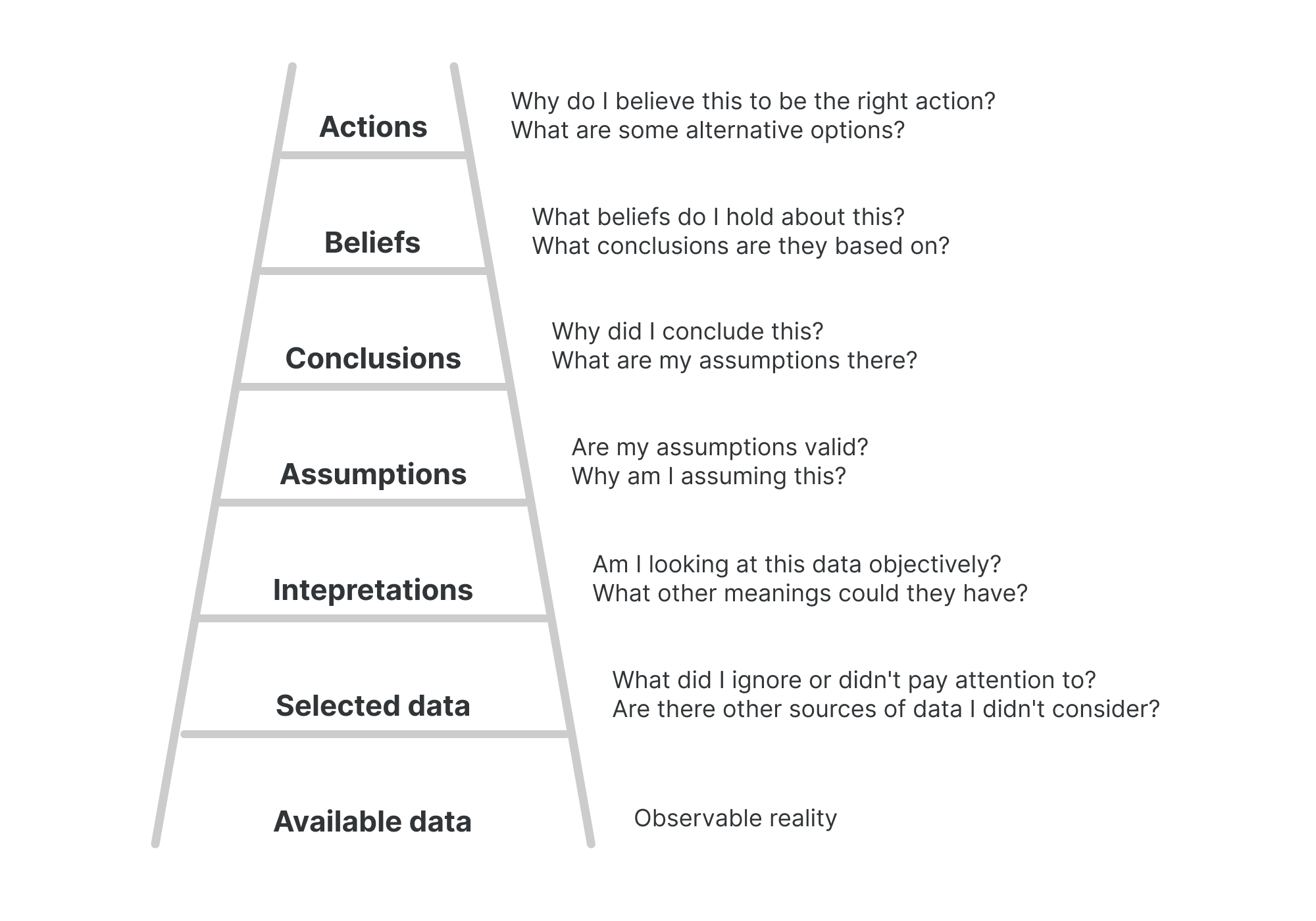
One of the most powerful tools within this framework is the Ladder of Inference, which helps practitioners recognize how quickly we form assumptions based on limited data. As Anissa Sonnenburg, an education administrator with the California Department of Education, explains, the tool encourages her to pause and say, “I think I’ve climbed the ladder, help me understand.” This simple shift (from assumption to inquiry)  models humility and transparency, allowing for more productive, human conversations.

The Ladder of Inference, Retrieved From https://untools.co/ladder-of-inference/

These tools remind us that compassion is not synonymous with leniency or avoidance. Rather, it means approaching challenges with understanding and curiosity, recognizing that problems often emerge from the structures we build rather than from individual shortcomings. When leaders begin with inquiry, they make space for shared accountability and collective problem-solving, which is the very foundations of psychological safety.

Cultivating System-Wide Well-Being

When compassion becomes systemic, its effects multiply. A grounded, reflective principal can influence the tone of an entire staff meeting; a teacher who models curiosity over control can transform a student’s relationship with learning; a district leader who begins conversations with check-ins rather than metrics can set the conditions for meaningful change. Compassionate systems leadership shows that well-being is not a byproduct of education, it is the soil from which authentic learning grows. As I continue this inquiry, I’m realizing that compassionate education requires us to widen our lens. It’s not only about how we teach students but also how we treat each other. It’s the emotional infrastructure that holds up everything else, the invisible network of trust, awareness, and care that allows schools to function as communities, not just institutions.

Free Inquiry Week 4: Compassion During Crisis

Rio the Dog – Photo Taken By Sophie Henderson

This week, my inquiry shifted from theory to lived experience. I reflected on a moment that tested not only my classroom management but my capacity for compassion under stress. It was an incident that has stayed with me for years, shaping how I understand trauma, regulation, and the weight children sometimes carry into learning spaces.

The Situation

I knew a child (let’s call him Taylor). Taylor was a child who carried invisible burdens. His father was inconsistently present, his mother worked far from home, and he spent most of his time with his grandmother, who openly rejected his ADHD diagnosis. Her dismissal of his needs left him confused and ashamed. I had noticed that when visits with his father approached, his behavior would often escalate. His energy would rise, his patience thin.

On this particular day, his usual support person was home sick, and our supervisor was away. During an activity, another child began to tease him, clearly trying to provoke a reaction. Taylor’s frustration erupted almost instantly. He lunged toward the other camper, who ran, and soon Taylor was throwing chairs and tables across the room. The substitute beside me began to cry.

In that moment, my instinct was to protect the other children first, so I asked her to take them to the gym. I stayed behind and moved objects out of his reach. My heart was pounding. I told him, as calmly as I could, that I could see he was upset and that I was sorry he felt that way, but I could not help him until he was calm. I watched as he eventually turned his anger toward the pillows I had placed nearby. When his energy subsided, he collapsed to the floor. In that moment, I no longer saw an angry child. I saw a boy who looked unbearably young, small, and lost. 

When my supervisor returned, we called his parents. I sat beside him in silence while we waited. The sadness I felt was heavy. It seemed unbearably unjust that someone so young had to carry so much pain.

Applying Compassionate Practices

Looking back through the lens of compassionate systems thinking, I can see how several principles were already present, and how others could have deepened the response even further.

1. Seeing the Whole Child
Compassionate practice begins with understanding that behaviour is communication. Taylor’s outburst was not about defiance but distress. His reaction was rooted in fear, shame, and emotional disconnection. Recognizing that context allowed me to approach him with calmness rather than punishment. My choice to keep my voice steady and validate his feelings, “I can see how upset you are”, aligned with trauma-informed, compassionate practice. It acknowledged his humanity in the middle of chaos.

2. Maintaining Psychological and Physical Safety
Ensuring safety for both Taylor and the other children was essential. Removing potential harm and giving him space to release his energy safely honoured his need for regulation. In compassionate education, safety is the foundation upon which trust and learning rest.

3. Emotional Regulation as Modelling
In moments of crisis, the adult’s nervous system becomes the emotional anchor. My calm tone and steady presence helped contain the intensity of the situation. Yet internally, I was afraid and uncertain. However, looking back, it makes me think of something my dad told me. “The only one who knows you’re not confident is you.” Compassionate systems thinking invites educators to be aware of their own physiological responses. If I had known then what I know now, I might have taken a grounding breath or brief moment of self-compassion afterward to prevent emotional exhaustion.

4. Compassion for the Adults Involved
It would have been easy to feel frustrated with my coworker who panicked, but compassionate practice extends to colleagues as well. She was overwhelmed and frightened. Later, creating space for her to process the event, and acknowledging that it was a difficult day for everyone, could have modelled empathy and strengthened our professional relationship.

5. Restoring Community
In the aftermath, the other children felt unsettled. A compassionate classroom would take time to restore safety and belonging for them too. This could involve a calm circle the next day where students share feelings without blame, or a reflection activity about kindness and empathy. This helps children learn that conflict and emotion are parts of life, not reasons for exclusion.

6. Institutional Compassion
At a systems level, the situation also points to the need for consistent structures of support, such as clear behavioural plans, predictable adult relationships, and communication with families that respects cultural and emotional realities. Compassionate systems thinking asks schools to respond not just to the child, but to the system surrounding the child.

What Compassion Teaches Us

In retrospect, that day showed me that compassion is not passive. It is courageous. It requires remaining steady in the face of uncertainty, holding empathy even when the environment feels unsafe. Compassion does not mean excusing harmful behavior, but it does mean recognizing the pain beneath it and choosing to respond with humanity rather than fear.

This experience also reinforced a deeper truth: compassion must include the educator. If we do not extend gentleness to ourselves, we cannot authentically offer it to our students. That afternoon, I did the best I could with what I knew. And sometimes, that is what compassion looks like.

Photo Taken By Unsplash

Free Inquiry Week 3: Applied Compassion

Skookumchuk Fire Lookout – Photo Taken By Sophie Henderson

The Shift from Theory to Practice

This week, my inquiry deepened from understanding compassionate systems in theory to exploring how compassion is lived within classroom spaces. I began asking: What does it actually look like to create a compassionate classroom? How can educators model and nurture compassion not just between people, but also toward animals, nature, and oneself?

Research and professional standards emphasize that schools have an essential role in fostering environments where safety, belonging, and well-being are prioritized. As the Alberta Teachers’ Association writes, schools should “ensure a social and physical environment where there is safety, well-being and interconnected relationships… and create a compassionate culture every day of the year.” (ATA, 2015). These values transcend curriculum, they shape the moral and emotional climate of a school.

A compassionate classroom culture is rooted in relationships, respect, and inclusion. This includes not tolerating bullying or discrimination, encouraging stigma-free discussions around mental health, and promoting healthy, connected relationships both online and in person. Compassionate systems thinking suggests that when we attend to relationships first, learning naturally deepens, because students feel seen, safe, and valued.

Ways to embody this:

  • Use inclusive and empathetic classroom agreements, such as: “Treat all beings in our classroom and learning community with respect and compassion.” This language encourages kindness not only toward peers but also toward animals, nature, and the wider world.
  • Create rituals of care, such as daily gratitude circles, “kindness challenges,” or regular class check-ins that normalize emotional expression and mutual support.
  • Integrate lessons about self-care, healthy boundaries, and digital citizenship to help students develop emotional literacy and resilience.

Modeling Self-Compassion and Well-Being

Compassion cannot be taught effectively without being lived. Educators who model self-care and self-compassion demonstrate that human experience such as making mistakes, feeling stress, and needing rest is not only acceptable but healthy.

Some practical examples:

  • Be transparent about challenges: “I’m feeling a bit overwhelmed today, so I’m taking a mindful breath before we start.” This models emotional regulation.
  • Introduce self-compassion breaks: brief, structured pauses where students (and teachers) acknowledge their emotions and offer themselves kindness.
  • Promote staff wellness: create or participate in schoolwide initiatives that value teacher well-being, such as walking clubs, mindfulness sessions, or shared gratitude practices.

As the ATA framework emphasizes, “Promote staff wellness and act as role models.” Students often mirror the emotional tone of their teachers; a calm, grounded educator communicates safety and trust.

Embodying Compassion Through Everyday Interactions

Compassion is communicated most powerfully through presence.

  • Nonverbal communication: Smiling, softening your tone, making eye contact, and maintaining open body language conveys warmth and approachability.
  • Verbal communication: Use affirming, gentle language. Statements like “I’m glad you’re here” or “I can tell you’ve been thinking deeply about this” strengthen students’ sense of belonging.
  • Compassionate listening: Give full attention when a student speaks. Validate their feelings before offering advice. Sometimes the most healing act is listening without fixing.
  • Consistency and follow-through: Keeping promises and maintaining predictable routines builds trust and stability, especially for students who may not experience those qualities elsewhere.

Compassion in education is systemic. It is not a single program or policy, but a living ecosystem of relationships, routines, and reflections. Each act of kindness contributes to the collective well-being of the classroom. When compassion becomes a norm, students begin to internalize it and extend it outward toward peers, the community, and the natural world.

This week, I learned that compassionate teaching begins with self-awareness. The classroom becomes a mirror of the educator’s internal state. When we model kindness, presence, and self-compassion, students learn that being human is not something to hide, it is something to honour and treasure

Reflection questions for readers:

  • What practices help you stay grounded and compassionate in the classroom?
  • How can compassion extend beyond people to include the natural world?

Free Inquiry Week 2: Big Ideas and Research

Bowker Creek – Photo Taken By Sophie Henderson

Through my research, I’ve learned that a defining element of compassionate education is its resistance to traditional systems that prioritize exams over emotional well-being. The Global Compassion Coalition points out that “The pressure of repeated exams is known to correlate with increased stress and anxiety among pupils. A study in the UK reported that 94% of teachers believe pupils are driven toward stress-related conditions during exam season.” The report also speaks to how exams only measure a narrow range of knowledge and fail to capture skills like emotional intelligence, collaboration, or creativity. In this sense, a system centered on testing not only overlooks important dimensions of learning but also encourages competition rather than community. Compassionate education seeks to reverse that pattern. Instead of teaching students to outperform one another, it aims to create conditions where they can thrive alongside one another.

This idea is echoed in Luba Vangelova’s work with Charter for Compassion, as described in To Advance Education, We Must First Re-imagine Society. Vangelova argues that reform efforts often fail because they focus on fixing schools rather than rethinking the values that shape our entire society. She looks to the work of John Abbott, of the 21st Century Learning Initiative in her account. Vangelova asks whether we want a world of independent, community-minded adults or one of consumers who depend on products and authority figures to define their choices. Her view is that our education systems mirror the latter. Built during the Industrial Age, they were designed to produce compliant workers rather than curious thinkers. As a result, students have been conditioned to absorb information and follow directions rather than question, connect, or create.

Vangelova envisions an entirely different kind of learning. One that mirrors biological growth rather than mechanical efficiency. Children, she notes, are “born to learn” and naturally driven to make sense of the world through exploration. When adults step back and create “highly challenging but low-threat environments,” young people develop a genuine desire to understand, not simply to achieve. Compassionate systems of education, then, require trust: trust in children’s intrinsic motivation, and trust in the learning process itself.

She also emphasizes that education should be a community-wide responsibility. Students need to see themselves as valued contributors, not passive recipients. This approach relies on relationships between teachers, families, and communities. Relationships that model empathy, interdependence, and shared responsibility. She quotes, teachers should act as “imaginative, knowledgeable guides” who spark curiosity rather than deliver information. Engaging a class in a spontaneous discussion about war illustrates how real learning emerges from dialogue and connection, not memorization.

While we could critique the system at large, other programs show what compassion can look like in practice. The Global Game Changers (GGC) program, described by Erin Skarda in How Teaching Compassion Empowers Kids to Make the World a Better Place, offers one such example. This initiative uses the equation my talent plus my heart equals my superpower to help children recognize their capacity to contribute to their communities. Students learn that compassion is not a separate moral lesson but a part of who they are. The program has been linked to improvements in academic achievement, self-confidence, and classroom climate. Teachers who participated in the pilot program described more creative, positive, and engaged learning environments, even within the pressures of standardized testing.

What stands out to me about programs like GGC is their belief that compassion can be both a moral compass and a pedagogical strategy. When children learn to give back, they also learn to see themselves as capable, valued, and connected. This sense of belonging and purpose seems to be what traditional education often misses.

In exploring these ideas, I am beginning to see compassionate education as a shift in both mindset and structure. It challenges the belief that success can be quantified through grades and instead focuses on nurturing empathy, community, and curiosity. The more I learn, the more I recognize that compassion in education is not just about kindness, it’s about redesigning the very systems that shape how children see themselves and the world.

Next week, I will be learning about specific compassionate practices and their outcomes, exploring how they look in real classrooms and what effects they have on student well-being and learning.

Free Inquiry Week 1: “What impact do compassionate practices have on student well-being and learning?”

Ocean Spray – Photo Taken By Sophie Henderson

I had my first official introduction to Compassionate Systems on my 6 week practicum. My practicum was at a school where the majority of students were reactive and had high needs. My mentor had been participating throughout the year in monthly meetings for “SEY2KT” (or “Strengthening Early Years to Kindergarten Transitions”). A core concept of these meetings was compassion. The meetings were put on by BC Compassionate Systems Leadership Network. Their website states “Compassionate Systems Leadership (CSL) is an approach to leadership that explicitly builds skills and practices in three interconnected domains: self (building a practice of personal reflection, mindfulness and compassion), each other (building authentic relationships that can support generative conversations), and the system (developing skills and capabilities to use tools that honour the complexity of the work that needs to be done).

There’s quite a few pillars to compassionate systems. Compassion, Diversity or Perspective Taking, Generative Space, Leadership, Present Awareness, Relationships and Reflection, Systems Thinking, and Well-being. All of these components work together to enable teacher, student, administration, community, and systems to operate from a lens of compassion. 

I was so inspired by these meetings. The room was full of primary teachers from the district. Every person there was there for their students and their community. They were advocating for compassionate systems for all of their students in a universally designed way, to have compassionate systems in place to catch their hard to reach students and families, while boosting all families. Looking around that room, I saw the kind of teacher I wanted to be. I wanted to be the teacher who leads with “courageous kindness”. I want to be the teacher who experiences the suffering of my students, and does whatever I can to alleviate it, while also looking after myself. 

I saw the principles of compassionate systems being naturally implemented in my practicum school. And despite the high needs, the people in that building were showing up not just to work everyday, but they were showing up for their students. Throughout this inquiry, I seek to find the real world results of compassionate systems. I’m curious for how exactly compassionate practices have an impact on students, not just their learning but also their well-being. I’ll be interviewing people trained in compassionate systems, as well as people who are not. I’ll be doing research, and trying to find real world applications. 

I’m so excited for this journey, thank you for coming along! 

Week 2: Epic! Books Review!

When I first discovered Epic Books, I was struck by how easily it could into a modern classroom. Epic is a leading digital reading platform designed for children aged 12 and under, offering access to over 40,000 high-quality books, audiobooks, and educational videos. The platform is free for teachers to use during school hours and provides a paid subscription option for families at home. Its library is curated specifically for kids, which means I can comfortably allow students to explore without worrying about inappropriate or mature content.

Epic’s founders describe their mission in a way that captures what makes it special:

“Epic was born out of a single question: How do we make books more accessible to kids? As parents, it always seemed strange to us that our kids could so easily play games and watch videos on their iPhones and iPads, but the same couldn’t be said for books. So in 2013, we decided to build the first ‘epic’ reading experience, designed just for kids. Today, Epic has grown into an award-winning subscription service, which gives millions of families and classrooms instant, unlimited access to thousands of books, videos and quizzes from leading publishers to help kids everywhere read, learn and grow.”

That idea of accessibility resonates deeply with me. As a teacher who is particularly passionate about literacy, I am always looking for ways to make reading feel approachable and enjoyable for every student. Some children naturally gravitate toward books, but others need an entry point that feels less intimidating. I think Epic has lots of potential for bridging that gap. The audiobooks, for example, are a wonderful way to spark a love for storytelling in students who may not yet see themselves as readers. Listening to a story read aloud can build comprehension, vocabulary, and imagination, while also showing that reading is not confined to printed pages. For some students, this can become a gateway into picking up physical books later on.

I imagine using Epic during literacy centers or independent reading time. One student might listen to an audiobook while following along with the text, while another flips through a comic. The platform also offers quizzes and Read-to-Me options, which add interactive elements that help students engage more deeply with what they are reading. It could also work well in a calm corner. If a student needs a moment to regulate, giving them the option to listen to a soothing story or quietly explore a digital book could help them refocus before returning to the group.

Another feature I appreciate is how easy it is to personalize. Teachers can assign specific books based on reading level or topic, or simply let students browse freely. The recommendations adapt to each child’s interests, helping them discover new stories that match their preferences. Because the environment is ad-free and designed for children, I don’t have to worry about what they might encounter, which is not always the case with public digital libraries or open web searches.

There is also potential for using Epic to support cross-curricular learning. For instance, during a science unit, students could explore informational books about habitats or weather patterns. During social studies, they could listen to biographies or historical stories. These connections make reading feel relevant beyond language arts and help students see literacy as a tool for curiosity and discovery.

Here’s a little video of a classmate and I showing you around Epic: 

I can absolutely see myself using Epic in a classroom, it’s very versatile and student-friendly!

Week 1: My Own Experience With Social Media.

Peaceful night in the mountains with no service – Photo taken by Sophie Henderson

My experience with social media mirrors that of many people my age were shaped by the rapid evolution of digital spaces that emerged as I grew up. I joined Instagram in 2012, when I was starting seventh grade, during a time when the platform still felt experimental and unmoderated. Social media then was a frontier of self-expression. I wish now that there had been clearer boundaries or that my parents had understood how deeply these platforms would shape our understanding of connection, popularity, and self-worth.

In those early years, I posted constantly. My feed was filled with selfies edited to extremes, captions stuffed with hashtags, and photos framed by heavy vignettes. I made and shared Vampire Diaries “memes,” though we did not call them that yet, and sometimes posted thirty in a single day.

I was endlessly entertained by my own creations. That changed suddenly in eighth grade, when a classmate casually mentioned that my constant posting was annoying. It was a small comment, but at the time it felt humiliating. That afternoon, I archived my account and started a new one. I can still access the old one, a digital time capsule of 761 posts. Looking back, that moment marked the beginning of my awareness that online spaces are not neutral. They are social environments, shaped by the same power dynamics, hierarchies, and vulnerabilities as real life. It’s fun and silly to have the digital capsule and I’m glad I have a clear snapshot of what was going through my preteen brain, but I’m also so embarrassed I ever posted so much of it to begin with! 

My parents, like many at the time, had strong opinions about online safety but uneven digital literacy themselves. Facebook was off-limits because it was “too adult,” and YouTube was treated as dangerous, yet I had unrestricted access to Instagram, Pinterest, and Kik. It is almost endearing to recall how easily I blurred fantasy and reality. At one point, I became absolutely convinced that Harry Styles had personally messaged me through Pinterest and invited me to his concert in Toronto. I told all my friends we would have fallen in love if only my mother had let me go. That memory makes me laugh now, but it also reminds me how ill-equipped many young people were to navigate online spaces critically. We lacked the tools to discern authenticity, evaluate credibility, or recognize the constructed nature of digital content. 

As I grew older, my relationship with social media became more strategic. I learned the unspoken rules of “coolness.” and what governed what acceptable media usage: post rarely, make it look effortless, and above all, appear curated but authentic. Slowly, my private life and my online life drifted further apart. What I shared became a curated snapshot rather than an honest reflection. My digital persona became more about how I wanted to be perceived than who I actually was.

In 2019, I began working for a small local shop and was responsible for managing their social media. This experience reframed my understanding of these platforms. I learned how to post consistently, design cohesive visuals, and engage with an audience in ways that built community. I discovered how social media could be used not only for self-promotion but for storytelling and advocacy. That position led to a similar role managing social media for the Indigenous Studies program at the University of Victoria during my undergraduate degree. I covered events, created newsletters, and highlighted student and community achievements. Around the same time, I worked as an assistant to a realtor, managing his listings and digital marketing. Through these experiences, I came to see social media as a professional tool, one that can amplify voices and create meaningful visibility when used thoughtfully.

Today, I find myself in a more complicated relationship with social media. I no longer manage it for others, and I use it less actively for myself, though I still spend more time observing than I would like to admit. Since deciding to become a teacher, I have become more conscious of how I am perceived online. In education, public image carries real professional consequences. Digital literacy for educators extends beyond knowing how to use technology; it involves understanding privacy, ethics, and the ways online behavior can shape credibility and trust.

Outside of teaching, I love to cook and host large dinner gatherings when I am home, sometimes for fifteen or more people. I often see creators online documenting similar experiences beautifully, transforming ordinary evenings into visual narratives. A part of me is drawn to share my own gatherings that way, but another part hesitates. I think my early experiences online taught me both the power and the precarity of visibility. I have worked really hard to reach this point in my professional journey, and I want to protect that. For now, I am content to let some moments exist offline. Perhaps that is my most valuable lesson in digital literacy so far: knowing when to engage with the digital world, and when to be in the real one. 

Welcome and Introduction

Before proceeding with this first blog post, we expect you to consider your privacy preferences carefully and that you have considered the following options:

  1. Do you want to be online vs. offline?
  2. Do you want to use your name (or part thereof) vs. a pseudonym (e.g., West Coast Teacher)?
  3. Do you want to have your blog public vs. private? (Note, you can set individual blog posts private or password protected or have an entire blog set to private)
  4. Have you considered whether you are posting within or outside of Canada? This blog on opened.ca is hosted within Canada. That said, any public blog posts can have its content aggregated/curated onto social networks outside of Canada.

First tasks you might explore with your new blog:

  • Go into its admin panel found by adding /wp-admin at the end of your blog’s URL
  • Add new category or tags to organize your blog posts – found under “Posts” (but do not remove the pre-existing “EdTech” category or sub-categories, Free Inquiry and EdTech Inquiry). We have also pre-loaded the Teacher Education competencies as categories should you wish to use them to document your learning. If you would like to add more course categories, please do so (e.g., add EDCI 306A with no space for Music Ed, etc.)
  • See if your blog posts are appearing on the course website (you must have the course categories assigned to a post first and have provided your instructor with your blog URL)
  • Add pages
  • Embed images or set featured images and embed video in blog posts and pages (can be your own media or that found on the internet, but consider free or creative commons licensed works)
  • Under Appearance,
    • Select your preferred website theme and customize to your preferences (New title, etc.)
    • Customize menus & navigation
    • Use widgets to customize blog content and features
  • Delete this starter post (or switch it to draft status if you want to keep for reference)

Do consider creating categories for each course that you take should you wish to document your learning (or from professional learning activities outside of formal courses). Keep note, however, that you may wish to use the course topic as the category as opposed to the course number as those outside of your program would not be familiar with the number (e.g., we use “EdTech” instead of “edci336).

Lastly, as always, be aware of the FIPPA as it relates to privacy and share only those names/images that you have consent to use or are otherwise public figures. When in doubt, ask us.

Please also review the resources from our course website for getting started with blogging:

Newer posts »

© 2026 ms henderson

Theme by Anders NorenUp ↑