Category: Educational Technology Presentation

This is the category to apply to your Educational Technology Presentation project work.

Week 8: EdTech Presentations

Victoria, BC Skyline – Photo Taken by Sophie Henderson

Reflecting on Classroom Technology Presentations

This week our class presented a series of projects on technology in education, each exploring a different angle on how digital tools shape learning. As we moved through the presentations and compared my notes, a clear theme began to emerge. Every group, regardless of their topic or stance, returned to the same central idea. Intentionality. Technology can support learning in meaningful and creative ways, but only when educators use it with clear purpose, thoughtful design, and awareness of its impact on students.

Further information on my own presentation can be found here.


Unplugged or Unprepared: Rethinking Digital Literacy

The first group I heard from examined the relationship between digital literacy and internet awareness, highlighting an important distinction. Internet awareness involves understanding the risks, implications, and habits associated with online behaviour. It includes mindful screen time, safe decision making, and an awareness of online security. Digital literacy, on the other hand, refers to the ability to use digital tools to locate information, analyze content, create new ideas, and communicate effectively.

This distinction shifted my thinking. The presenters argued that students in tech free classrooms are not necessarily at a disadvantage in the long term, because schools can always provide structured catch up instruction. In fact, a tech free environment may improve attention, play, and social skills. What mattered most was the intentional return to digital learning when appropriate and not simply assuming that students must be immersed in technology daily in order to succeed.


Balancing High Tech, Low Tech, and No Tech

The second group explored the spectrum of high tech, low tech, and no tech learning environments. High tech classrooms use many digital tools. Low tech approaches rely on simple or streamlined technologies. No tech environments prioritize holistic, full body learning without devices. As a class, we generally leaned toward a low tech preference. The consensus was that technology can contribute positively to learning, but only when it is used with clear purpose rather than convenience or habit.

This finding connected directly back to the emphasis on intentionality. Student teachers consistently expressed that technology should serve learning goals rather than distract from them.


Essential Skills and Meaningful Use

The third group focused on the importance of protecting essential low tech skills such as reading and writing. They reminded us that technology should never replace relationships or diminish the human elements of teaching. They also pointed out that low tech spaces can create accessibility barriers for some learners, which again speaks to the need for thoughtful planning.

Their best practices resonated with me;

  • Use technology only when it clearly supports the learning goal.
  • Ensure that digital tools encourage active engagement rather than passive consumption.
  • Teach students to use technology responsibly and with purpose.

These ideas reinforced the overall message that technology must be woven into learning with clarity and care.


Safety, Surveillance, and Student Trust

The final group discussed technology in relation to safety and supervision, including the presence of cameras and predictive analytics. While these tools can reduce vandalism and increase feelings of security, they can also shift the tone of the classroom. Excessive monitoring risks creating an environment that feels controlled rather than supportive. The group emphasized that safety measures should be introduced thoughtfully, with clear communication to parents and a healthy balance between supervision and autonomy.

Their presentation added another dimension to the theme of intentionality. Even when technology is designed to protect, teachers must consider how it affects trust and belonging.


A Shared Message Across Every Group

Across all four presentations one message was obvious. Technology certainly has a place in the classroom, but it must be used with intentionality, forethought, and care. Student teachers clearly recognize that digital tools offer enormous potential, yet they also understand the risks of over reliance. The goal is not more technology or less technology. The goal is meaningful technology. The kind that strengthens learning, deepens relationships, supports safety, and respects the developmental needs of students.

In the end, thoughtful integration will always matter more than the number of devices in a room.
Virtual Field Trips Through the Lens of Accessibility

Going into this project, my group and I selected the inquiry question “How can virtual field trips enhance accessibility and engagement for elementary students with diverse learning needs?”. As a teacher candidate, field trips initially felt quite daunting. During my six week practicum, I worked with a Kindergarten class that included many diverse learners with high needs, and I often wondered how an in person excursion would even be possible. Some students had mobility challenges, others required one to one support, many likely would have faced financial barriers, and the class spoke several languages and had inconsistent attendance. The age level added further complications because early primary students require extensive preteaching in order to participate safely and meaningfully.

As I reflected on all of this, I realized that these challenges made the idea of a Virtual Field Trip far more appealing and appropriate. It provided a way to imagine learning opportunities that would not leave anyone out.

I had also been introduced to the “Wolves in the Walls” virtual reality experience in my 402 class the year before. That activity, as well as a later simulated train journey, stayed with me and encouraged me to think about how technology infused experiences could enhance learning in my future classroom.

I was genuinely excited to investigate Virtual Field Trips more deeply. I wanted to understand their potential not only as engaging activities, but also as meaningful accessibility tools that support equitable learning.


My Role in the Project

My contribution to the project focused on three key areas.

First, I researched the history and evolution of Virtual Field Trips.
Second, I explored how they can foster inclusion, creative thinking, and student engagement.
Third, I examined strategies for effective planning, ensuring that Virtual Field Trips align with thoughtful and intentional pedagogy.


How Does This Relate to Teaching and Learning?

The connection is extensive and meaningful. Field trips of any kind are inherently learning experiences that expand student thinking and curiosity. While I do not believe Virtual Field Trips should entirely replace in person trips, I do believe they play a significant role in complementing them.

Virtual Field Trips provide equitable access to places and concepts that many students may never experience in person. They can serve as exposure tools, allowing learners to explore global locations or examine how certain places have changed over time. Most importantly, they provide multiple entry points for the entire class, including students who face barriers with traditional excursions.


Pros, Cons, and Risks

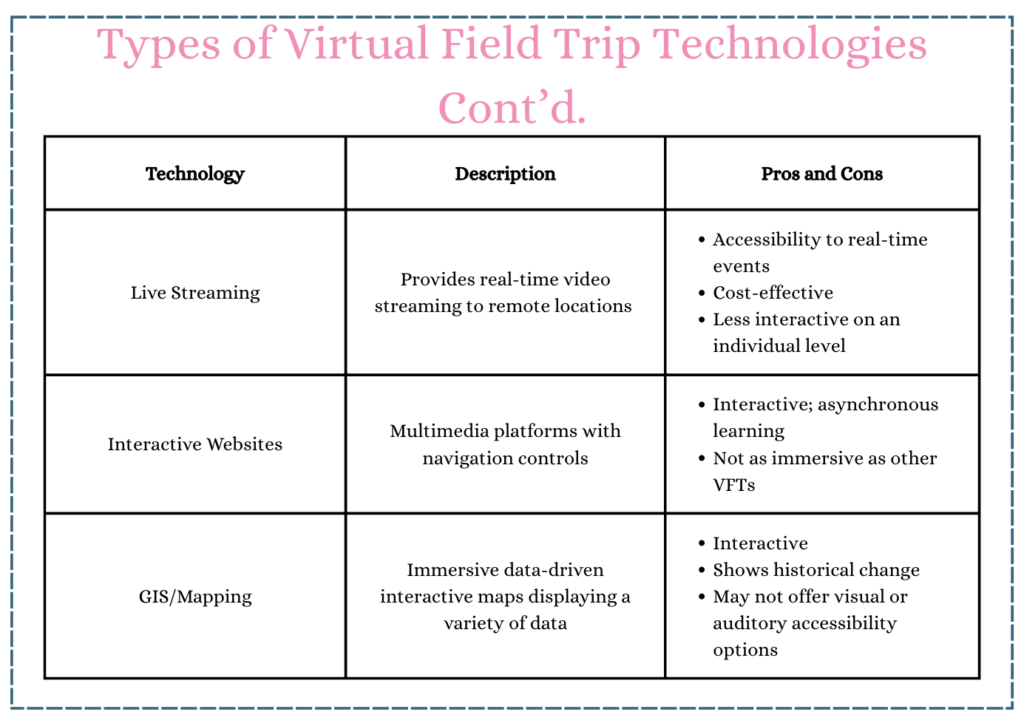
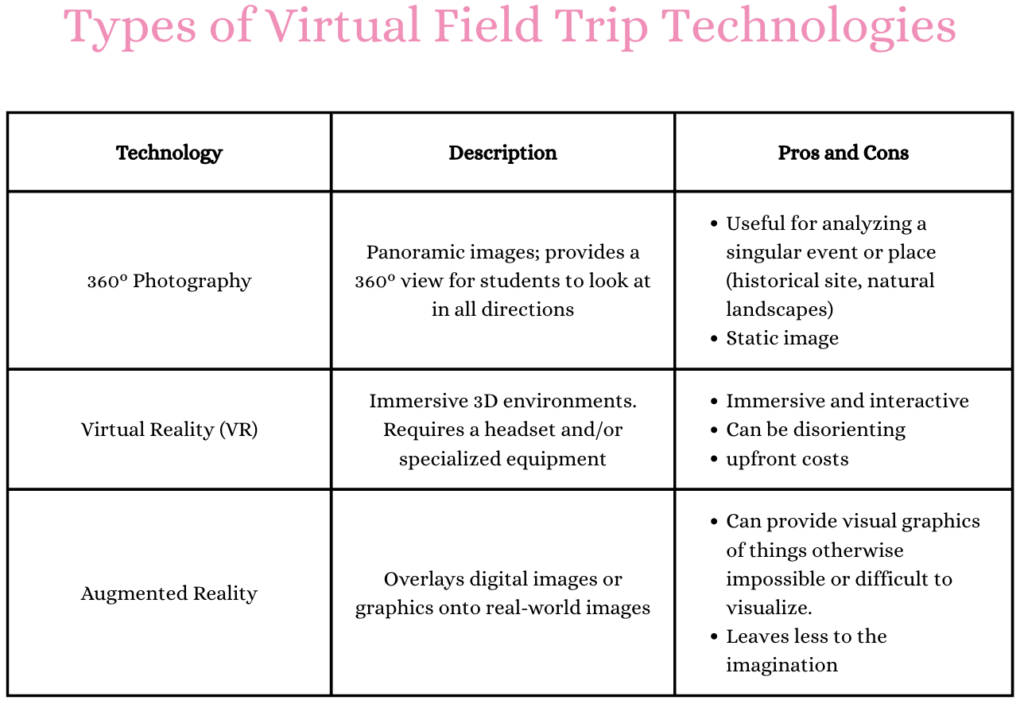
My peer outlined several categories of Virtual Field Trips, each with their own features.

The broader considerations include the following.

Pros

Virtual Field Trips can
• broaden student worldviews
• support accessibility through Universal Design for Learning principles
• provide safe and controlled environments for learners with higher needs
• create inclusive shared experiences for the entire class

They give students opportunities to explore settings that would otherwise be unavailable and can enrich their sense of connection to the world.

Cons

There are also notable challenges.
• Technology can be expensive, even for basic setups.
• Reliable internet access and devices are essential.
• More immersive tools such as augmented or virtual reality may not be financially possible in many schools.

Risks

A key risk is the possibility that teachers may begin relying on Virtual Field Trips instead of real world experiences. Authentic in person field trips remain valuable for social development, community engagement, and hands on learning, and they should continue to hold an important place in education.


Strategies, Best Practices, and Key Takeaways

The most important lesson I am carrying forward is the need for clear and purposeful intent. Virtual Field Trips must be planned with the same care and thoughtfulness as any other learning experience.

Teachers should
• consider the specific needs of their learners
• evaluate the technology available
• identify the precise learning outcomes
• build in reflection, discussion, and guided inquiry

A Virtual Field Trip should involve meaningful immersion, not passive screen time. It should promote higher level thinking and genuine curiosity. Simply plopping students in front of Google Earth will not produce deep understanding without guided structure and reflective engagement.


Our Artifact

My group created a Screencast for our artifact. I used a framework I found to create a Virtual Field Trip using Google Earth, and followed the steps to show my listeners. One of my group members used Thing Link to create a 360 Virtual Field Trip, and another walked through a Dinosaur Virtual Field Trip.

The artifact can be found by following this link: https://www.canva.com/design/DAG5AKz4ehY/AT9OtlhuaSPOsgy_JQa7Dg/edit

Going Forward

This project has significantly shaped my understanding of what Virtual Field Trips can offer. When designed with intention and aligned with student needs, they become powerful tools for inclusive education, accessibility, and creative exploration. They allow every student to participate in experiences that might otherwise be unreachable. Although they cannot and should not replace the richness of real world excursions, they can stand alongside them as innovative and equitable companions.

© 2026 ms henderson

Theme by Anders NorenUp ↑