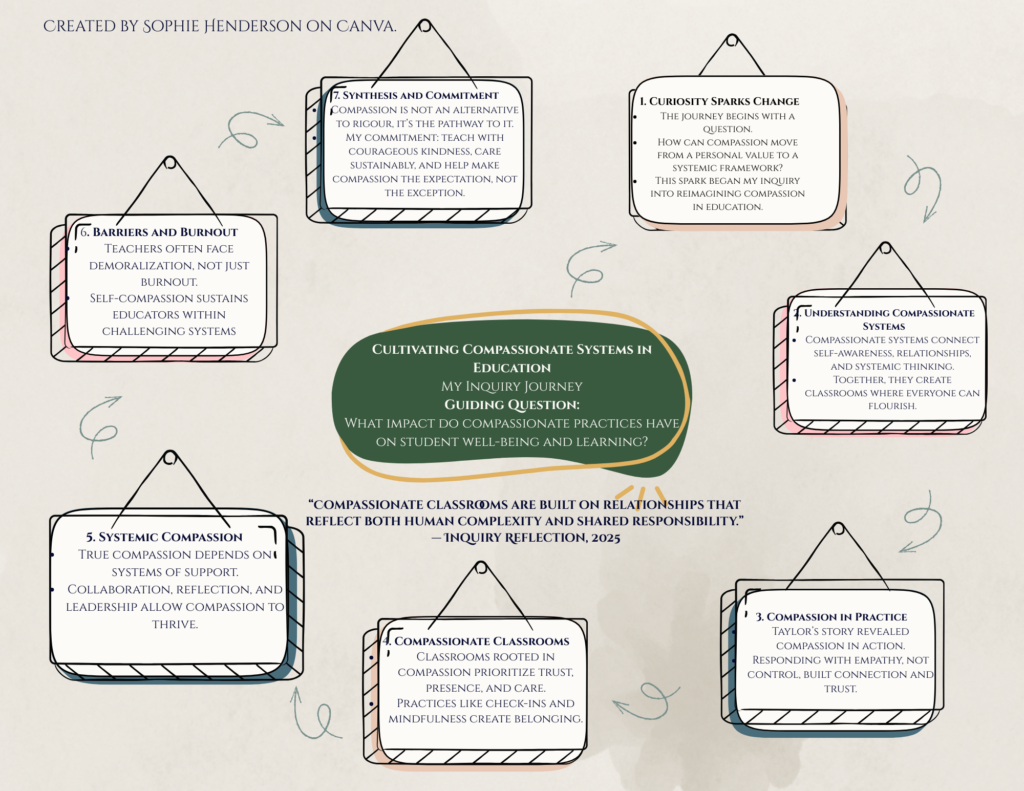

As I look back over this inquiry, I am struck by how deeply compassion connects every part of education. What began as curiosity about “compassionate systems” has become a recognition that compassion is not just a quality of good teaching, it is the foundation of meaningful learning and authentic connection.
In my first week, I wrote about my introduction to Compassionate Systems Leadership, and how that experience reshaped my understanding of what it means to show up for students. Surrounded by educators who led with empathy and intention, I saw compassion not as an abstract ideal but as a practical framework for transformation. That moment helped me define the kind of teacher I want to become: one who leads with courageous kindness, grounded in awareness, reflection, and genuine care for others.
By Week 2, I began to see that compassion challenges the traditional systems that dominate education. The readings from the Global Compassion Coalition and Luba Vangelova revealed how our current structures often prioritize efficiency over humanity. Compassion calls for a reimagining of education, where learning is measured not only by outcomes but by connection, curiosity, and well-being. I began to realize that compassion is not just emotional, it is structural. It requires us to rebuild systems around people, not performance.
In Week 3, I explored what compassion looks like in everyday classroom life. It is found in the tone of a teacher’s voice, in a moment of patience, in the calmness of a morning check-in. I learned that compassion is not a single act but a habit of presence! It’s a choice to respond with understanding instead of reaction. Teaching compassion begins with embodying it ourselves, and that takes both emotional intelligence and consistent self-reflection.
Week 4 brought theory to life through experience. I wrote about a child I knew, whose emotional outburst revealed deep pain beneath the surface. That day, I learned that compassion is not just about softness, it is also strength. It is standing steady in the midst of chaos, choosing empathy even when fear is easier. It also reminded me that compassion must extend beyond students to include colleagues, families, and ourselves, because systems of care cannot survive when adults are running on empty.
By Week 5, my focus expanded to the systemic level. The BC Mental Health in Schools Strategy describes Compassionate Systems Leadership as an essential part of supporting both student and adult well-being. Its three core elements (internal work, relationship work, and system work) offer a roadmap for embedding compassion throughout education. I was especially drawn to the idea of how you show up. When we arrive grounded and attentive, we invite others to meet us with the same energy. Leadership, at every level, seems to begin with presence.
In Week 6, I turned toward the realities that threaten compassion in schools. Many educators experience what Santoro describes as demoralization, not because they care too much, but because they are asked to care within systems that do not always care back. I learned that self-compassion is not indulgence, it is survival. To sustain compassion for others, we must create cultures where teachers are supported, not depleted.
Through this inquiry, I have come to understand that compassionate systems of education are not an alternative to academic rigor but the means through which it can flourish. Compassionate classrooms are built on relationships that reflect both human complexity and shared responsibility. They ask educators to see themselves not as deliverers of information but as facilitators of connection and growth.
In a time when teachers face immense pressure and students navigate growing social and emotional challenges, compassion offers a sustainable path forward. It asks us to slow down, to listen deeply, and to see our classrooms as communities of care. This inquiry will continue to evolve as I enter the profession, but my commitment remains clear: to teach with courageous kindness, to care without burning out, and to work toward an education system where compassion is not an exception but the expectation.As I close this inquiry for now, I see that compassion can be both the anchor and the catalyst of educational transformation. It grounds us in our shared humanity, reminding us that behind every behaviour is a story, and behind every policy is a person trying to do their best. Compassion challenges us to lead differently, teach differently, and most of all, to see differently. I look forward to starting my career, and making compassion a central and foundational piece of my practice!